Over the course of extensive research spanning years, a compelling body of evidence has emerged challenging the historical narrative surrounding the death of Jesse James. This comprehensive collection of evidence encompasses Jesse James’ journal entries, his use of aliases, family photographs, forensic analyses by reputable experts, DNA testing, historical records, and intriguing accounts of treasure maps. In this dossier, we will delve into each category while also exploring recent revelations from ballistics tests that cast doubt on the claims made by Bob and Charley Ford regarding the fatal shooting of Jesse James.
I. Jesse James’ Journal Entries (1871-1876): Jesse James meticulously documented his life in a journal from 1871 to 1876, revealing intriguing details that align with the activities of the infamous James gang. His use of the signature “J. James,” initials “JWJ,” and references to known gang members place him at the scenes of the gang’s criminal activities. Noteworthy is the inclusion of Colonel Tom Pickett, whose son rode with Billy the Kid, further linking James to a network of infamous figures.
II. James L. Courtney Alias: An alias utilized by Jesse James, James L. Courtney, is explored in depth. This alias, a cousin of Jesse James, contradicts the physical description of our great-great-grandfather provided by authentic military papers. The real James L. Courtney, a bugler in the Union Army, bears no resemblance to our ancestor in height or hair color. This revelation is one of many that add credence to the notion that Jesse James employed various aliases to conceal his true identity.
III. Family Photographs: Photographic forensic experts have meticulously verified family photographs handed down through generations, confirming the authenticity of images depicting Jesse James and his family members. Notably, a photograph capturing Jesse James and his brother Frank James with Frank’s wife Annie Ralson is believed to be their wedding photo. Historical context is added as known farmers from Blevins, Texas, verified by a descendant, are identified in the same photograph, strengthening the claim that Jesse lived under his alias in the area.
IV. Funeral Photographs: Contrary to historical accounts, photographs allegedly depicting Jesse James’ funeral are scrutinized. Wood Hite, purportedly in the coffin, is identified as Jesse’s cousin, appearing alive in the same photo as Jesse and his mother. Expert analysis reveals discrepancies in the wounds attributed to Jesse James, raising questions about the authenticity of his demise.
V. Forensic Experts’ Confirmation: Three esteemed forensic experts—William McCann, Karen Taylor, and Visionics—have independently confirmed discrepancies in alleged death photos and provided written validation of their findings. Their expertise in facial recognition technology and forensic analysis casts doubt on the veracity of the historical account surrounding Jesse James’ death.
VI. DNA Testing: Led by our late mother, Betty Dorsett Duke, an investigation into the 1995 exhumation and subsequent DNA testing of Jesse James’ purported grave and bones exposes major flaws in the process. Clay County Commissioner Stephen Caruso dismisses the endeavor as a “tawdry sideshow.” Further revelations unveil that the tested bones were not from the exhumed grave but were acquired from the James Farm yard in 1978.
VII. Census, Birth, Death, Marriage, Historical Records: An extensive collection of census, birth, death, marriage, and Civil War records spanning over two decades forms the foundation of our genealogical claims. A critical examination of the 1882 coroner’s inquest in St. Joseph, Missouri, highlights inconsistencies in the stories surrounding Jesse James’ alleged assassination.
VIII. Treasure Maps: A fascinating element of our evidence includes treasure maps handed down through the family, describing alleged locations of Jesse James’ treasures. Additionally, a map drawn by George Roming, a 32nd Freemason and WWII veteran, provides insight into the burial of gold bars, suggesting a clandestine history intertwined with Jesse James’ activities.
IX. Ballistics Tests: Discrediting Bob and Charley Ford’s Claims The purported assassination of Jesse James by Bob and Charley Ford has been scrutinized through ballistics tests, providing significant revelations that cast doubt on the accuracy of historical accounts.
Contradictory Statements: Initial contradictions arose concerning whether the bullet exited the skull of the man believed to be Jesse James. Professor Starrs, who initially aligned with the coroners’ assertion that the bullet did not exit, later softened his stance, acknowledging the uncertainty due to the inability to fully reconstruct the skull.
Alleged Bullet Hole at Museum: Gary Chilcote, owner and curator of the house where Jesse was allegedly killed, asserted that the iconic bullet hole in the museum’s wall, a lucrative attraction, was created by the bullet fired from Bob Ford’s pistol as it exited Jesse James’ skull.
Ballistics Tests Disprove Claims: Definitive clarity emerged from ballistics tests conducted by Katarina Babcock, a New Mexico Department of Public Safety firearms expert. Featured on “Jesse James: Legend, Outlaw, Terrorist,” aired on October 29, 2005, Babcock fired shots from a Smith & Wesson 44 and a Colt 45 into ballistics spheres simulating the human skull, skin, and brain.
Exit Wounds and Contradictory Testimonies: Bob Ford, giving conflicting statements about the murder weapon, fired the fatal shot from approximately six feet, with his arm outstretched. The ballistics tests demonstrated that either weapon, fired from that distance, would have left exit holes. This directly contradicts Ford’s testimonies and calls into question the veracity of his claims.
Facial Integrity in Question: Babcock’s findings shed light on the alleged death photos of Jesse James, suggesting that the highly questioned corpse likely would not have retained its facial integrity if shot in the back of the head at the close range testified by Bob Ford. This raises further skepticism about the circumstances surrounding Jesse James’ death.
Additional Revelation: It is essential to note that the evidence presented in this dossier represents only the tip of the proverbial iceberg in challenging the traditional narrative surrounding Jesse James’ death. The depth of our investigation extends beyond the documented evidence, shedding light on previously undisclosed information that further questions the historical account.
Fraudulent 1995 DNA Results: Former Clay County Deputy Counselor Stephen Caruso, who played a pivotal role during the 1995 exhumation and subsequent DNA testing of Jesse James’ purported grave, recently disclosed critical information. Caruso revealed that the 1995 DNA results, heralded as conclusive proof with a 99.7-degree of certainty that Jesse James died and is buried as history reports, are fraudulent.
In separate conversations with Texan Betty Dorsett Duke and Missourian Greg Ellison, Caruso stated that he provided hair from John Hartman, Director of the Clay County Park’s Department, to Professor Starrs for DNA testing. This action circumvented the court order requiring the James Farm & Museum to hand over hair and teeth for testing, as ordered by Clay County Judge Vic Howard.
Caruso described the 1995 exhumation as “sanitized for public consumption” and referred to it as a “tawdry sideshow.” This revelation adds a layer of complexity to the investigation, suggesting that not only is the historical record of Jesse James’ death questionable, but also the scientific evidence presented in the 1995 DNA testing.
Betty Dorsett Duke, the great-granddaughter of Jesse James, dedicated over two decades to exhaustive research and authored three seminal books. Through her rigorous investigations, Duke unequivocally demonstrated that Jesse James did not meet his end as conventionally recounted in history. Instead, she conclusively proved that James orchestrated his death, leading a covert existence until the remarkable age of 97 in the rural community of Blevins, Texas. In her unwavering pursuit of truth, Duke faced unwarranted harassment and even death threats, underscoring the gravity of her findings that boldly assert Jesse James successfully faked his demise.
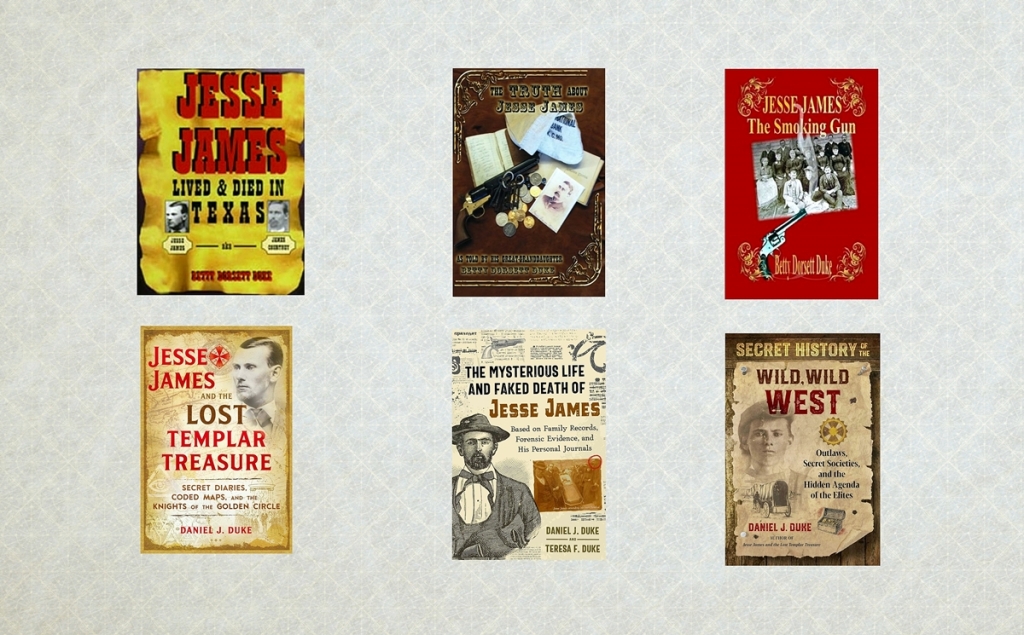
Betty Dorsett Duke’s children, Daniel J. Duke and Teresa F. Duke have continued their late mother’s work and authored three additional books revealing additional evidence, connections, proof and even treasures associated with Jesse James and his associates. Titles of Betty’s books as well as those written by Daniel and Teresa are listed below in chronological order.
Books by Betty Dorsett Duke:
‘Jesse James Lived and Died in Texas’
‘Jesse James – The Smoking Gun’
Books by Daniel J. Duke and Teresa F. Duke
‘Jesse James and the Lost Templar Treasure’ by Daniel J. Duke
‘The Mysterious Life and Faked Death of Jesse James’ by Daniel J. Duke and Teresa F. Duke
‘Secret History of the Wild, Wild West’ by Daniel J. Duke

 The Outlaw Jesse James
Leave a comment